What Schrödinger’s Cat Can Teach Us: How Observing Your Mind Changes Everything
By Aleks
Since I was a little child, I was deeply impressed by all sorts of animals—the small and the large. I felt a sense of wonder and admiration for the countless mammals, reptiles, birds, fish, and insects that fill our world. I loved learning about different species and observing them for hours, captivated by their behaviors, sizes, shapes, textures, and colors. The animal kingdom was full of life and astonishing diversity. It never became boring.
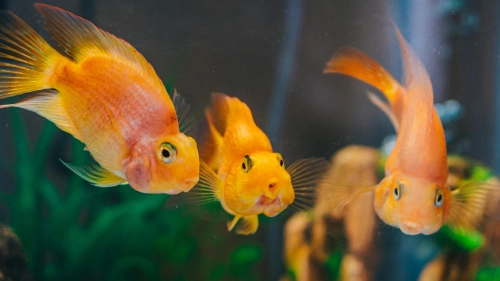
I especially remember visiting my two elderly neighbors. They had a huge, beautiful aquarium full of colorful fish gliding from one side to the other, chasing each other or hiding in the dense greenery. I visited them often and spent quite some time simply watching, completely absorbed. There were also a few stray dogs and cats in the neighborhood, little puppies and kittens we children adored playing with.
The animal kingdom always felt incredibly fascinating, like an entirely different world. It seems as if many animals possessed something that many people in today’s modern world have lost: a deep connection to nature and a sense of inner freedom.
It is hard to say what my favorite animal is, as so many of them deserve their own chapter, each fascinating enough to fill dozens of pages. Many wild animals (such as whales, apes, wolves or countless bird species) possess complex emotional lives, distinct personalities, and intricate social structures. However since I started meditation, one animal in particular began to stand out from the rest: the cat. There is something unmistakably mysterious about cats, an aura of independence, serenity, and alertness that feels almost meditative. Unlike dogs, who wear their emotions openly, cats seem to inhabit a quiet inner world of their own. Their stillness can feel like a lesson in presence; their sudden bursts of play are reminders of spontaneity. Cats have always seemed to operate on the border between worlds, half wild, half domestic; half asleep, half alert. It almost feels as if cats naturally live in the state we humans try to reach when meditating: completely relaxed but present, effortlessly observant, responding without overthinking. Watching a cat is like watching awareness itself: the stillness, the sharpness, the quiet readiness.
It is no wonder the ancient Egyptians saw them as sacred beings, guardians of the home, symbols of intuition and protection. They were cherished companions and were sometimes even mummified to accompany their owners into the afterlife. Cats embodied both gentle protection and fierce, predatory power, qualities reflected in goddesses like Bastet and Sekhmet. From ancient times to today, cats have never lost their captivating presence. In the 2024 award winning animated film “Flow” – acclaimed for its stunning visuals and dialogue-free storyline – the main protagonist, a black cat, navigates a flooded world together with other animals. The film explores themes of survival, community, and nature without using a single spoken word. Aside from natural sounds, silence carries the entire narrative. No words are needed to convey the story. The tension is palpable, yet the beauty of tranquility and stillness dominates.
How Schrödinger’s Cat comes into Play? Observation Changes Everything
Even today, watching a cat sit perfectly motionless, eyes half-closed, breathing softly, seems like they embody the paradox of being deeply relaxed yet fully aware. Perhaps that is why it feels almost fitting that the most famous thought experiment in quantum physics also centers on a cat. Cats have always carried a veil of mystery, but Schrödinger’s Cat elevates that mystery to an entirely new level. The ancient Egyptians worshiped cats for their supernatural elegance; modern physicists usesd a cat to illustrate the bizarre nature of reality itself: the idea that observation changes everything.
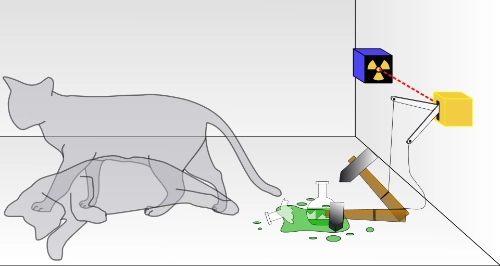
Erwin Schrödinger was an Austrian physicist and one of the founders of quantum mechanics. He was not just a brilliant theoretical physicist, he also had a playful approach to science. That is exactly how the famous “Schrödinger’s Cat” thought experiment was born. Schrödinger created it not to describe a real experiment, but to show how strange, almost absurd, quantum rules become when we try to apply them to everyday objects and forms like cats. The idea in quantum physics that tiny particles can be in two states at once until they’re observed. It asks you to imagine a cat in a box with a mechanism that might kill it or not. Until you look inside, the cat is both alive and dead at the same time. The completely hypothetical experimental setup goes like this:
Imagine you have a piece of radioactive material that has a 50 percent chance of undergoing nuclear decay within a certain amount of time (e.g. one hour). You place this material inside a sealed box together with a small glass vial of poison and a mechanism that will break the vial if the radioactive decay is detected. Then you put a living cat into the box, close the lid, and wait for an hour. Until someone opens the box to observe what happened, in your mind the cat could be considered to be both dead and alive simultaneously. Only when the box is opened again, when observation collapses possibility into outcome, does the cat’s fate become known.
It sounds impossible and that impossibility was precisely Schrödinger’s point. He never intended anyone to believe that real cats flicker between life and death. Rather, he wanted to expose the sheer absurdity that arises when the rules of the quantum realm are stretched into the everyday world we can see and touch.
In quantum mechanics, the act of observation determines the outcome. Until something is observed, multiple possibilities can coexist simultaneously.
How is This Connected to Meditation?
I remember well that before I began meditating, about four years ago, I was often overwhelmed by negative emotions, feeling stressed, angry, frustrated, restless, or even depressed. Daily life frequently felt heavy, as if the world were a hostile place filled with anger, self-doubt, futility, and darkness. Deep down I knew this was not the full truth, yet I still found myself wondering how and why this shift had happened from being a happy, mostly carefree, playful child to an adult who often felt stressed and weighed down by mental burdens.
It was not that I was permanently stressed or consumed by a single negative emotion. Like many people with similar experiences, I often used to move through my day almost unconsciously, on “autopilot.” My mind held many overlapping, half-noticed states filled with images, thoughts and emotions: anxious and calm impulses at the same time, worry mixed with curiosity, distraction alongside inspiration, happiness intertwined with sorrow. Many of these emotions and thoughts would arise simultaneously, often unnoticed from the background, shaping how I experienced the world.
My mind, with all its overlapping thoughts and images, often acts like “a cunning puppet master”, pulling multiple strings at the same time creating confusion. Meditation gave me the right tool to “cut the strings of the puppet master” when necessary, allowing me to free myself and act with more clarity.
During meditation, I often experienced profound shifts. A thought that once felt overwhelming, tangled with mixed emotions, could suddenly lose its power the moment I noticed it consciously and let it go. When I paused and observed my chaotic mind in stressful moments, something changed. Awareness “opens the box.” What once felt murky becomes clear. An anxious thought loses its grip. A subtle emotion comes into focus. Confusion gives way to clarity and more wisdom. Sometimes, even new ideas or sudden insights emerge seemingly out of nowhere.
It is much like Schrödinger’s Cat experiment, where the cat’s fate is uncertain until observed. When I find the courage to look closely and “open the box” by observing my mind with its myriad thoughts and emotions shaping my reactions and moods automatically, the burdens and negativity collapse, leaving a single clear insight, giving me the choice how to respond rather than being pulled unconsciously.
Meditation teaches us that the observer shapes the experience. Simply watching a thought can transform it. Attention collapses the swirl of mental possibilities into something understandable, workable, and often surprisingly peaceful. I have learned that when you pay attention, you do not just see more clearly, sometimes you can even change what you see. Over time thanks to this meditation method, by looking back, reflecting, and letting go of memories, thoughts, and images I have noticed a lasting transformation in my mind: less stress, fewer doubts, reduced chaos; more tranquility, clarity, wisdom, better decision-making, increased resilience, focus, courage, self-confidence, and a deeper sense of happiness, no matter what is happening in my life. I am deeply grateful for this opportunity. The process is ongoing, making it a truly exciting journey.
Schrödinger’s Cat is not just a quirky physics story. It reminds us that our inner world is full of unseen possibilities, and that conscious observation of the mind is the key to choosing which ones become real. Although it may sound as paradoxical as Schrödinger’s Cat itself, I genuinely believe that through regular practice of this meditation method by cleansing our mind, we do more than simply observe our mind without judgment. With clarity and courage, we begin to participate in shaping it. The inner world responds to awareness, and when we focus our awareness we can see what is true, thereby eliminating the imagined possibilities. You will find what is true is much better than any of those imagined possibilities. This meditation method is the path to become truly alive and free.
By Aleks Since I was a little child, I was deeply impressed by all sorts of animals—the small and the large. I felt a sense of wonder and admiration for…
By Neal The Picture Prison Once again as in my last article, “Beyond Boundaries”, I was inspired by a Native American perspective. Many Native American cultures held spiritual beliefs about…
By Vicky Life has a way of pulling us into chaos, through stress, emotional turbulence, shifting responsibilities, or unexpected changes in our environment. In these moments, our habits often become…